If you are planning to operate an independent dental hygiene practice, denture clinic, or dental laboratory, or become a practice owner in dental hygiene, denturism, or dental technology in Nova Scotia, you must complete the applicable requirements before beginning operations. Please review this section carefully to determine the steps that apply to you.
If the practice will operate as a professional corporation, you must submit a professional corporation permit application. If it will operate under another ownership model, such as a sole proprietorship or partnership, you do not submit an application. In either case, you must contact the Registrar and complete all applicable pre-opening requirements, including any required inspection, before providing professional services in that location.
Before opening a practice, review the legislation, regulations, standards, and any other requirements that apply to your profession. You are responsible for ensuring that your practice will meet all applicable professional and regulatory obligations.
Overview of the Process
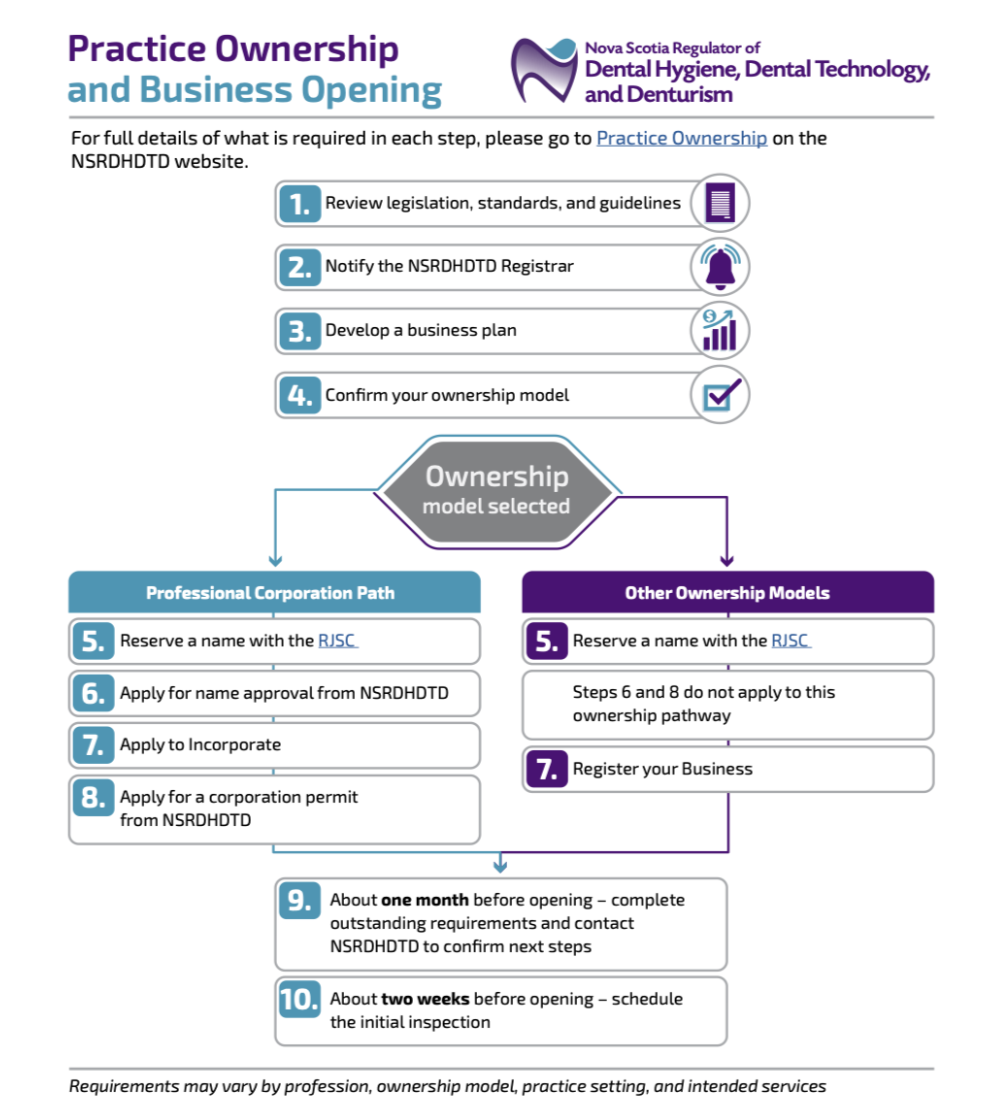
The overall process is similar across all three professions unless otherwise noted, but the requirements differ by ownership model. Professional corporations must submit a permit application. Other ownership models do not submit an application, but they must still contact the Registrar. In all cases, applicants must complete all applicable pre-opening requirements, including inspection where required, before providing professional services. See our Practice Ownership and Business Opening Infographic for more information.
- Confirm that you hold the appropriate registration and licence for your profession.
- Review the requirements that apply to operating an independent practice and/or becoming a practice owner.
- Contact the Registrar early to discuss your proposed practice, ownership model (e.g. professional corporation, sole proprietor), and next steps.
- Confirm your ownership model and complete any required business registration, name reservation, or incorporation steps.
- If you are seeking to operate as a professional corporation, complete the permit application and submit the required supporting documentation and fee.
- Complete any applicable pre-opening requirements, including inspection where required, before providing professional services.
What You May Need to Provide
The information and documentation required may vary depending on the ownership model, the nature of the practice, and the profession. You may be asked to provide:
- ownership and contact information
- practice location details
- information about the services that will be provided
- required policies, procedures, or other supporting documents
- any additional information required to assess your readiness to open and/or to approve your Professional Corporation application
If any requirements differ by profession or ownership model, those differences should be reviewed carefully before you proceed.
What Happens Next
Once you have contacted the regulator or, if applicable, submitted a professional corporation permit application, the next steps will depend on the ownership model and the nature of the practice.
- For professional corporations, this includes review of the application and permit requirements.
- For other ownership models, there is no application to submit.
Do not begin operating until you have completed all applicable pre-opening requirements and have received any required confirmation, approval, or permit from the regulator.
Ongoing Responsibilities
Operating a practice involves ongoing responsibilities. Practice owners must continue to comply with the legislation, regulations, standards, and any other requirements that apply to their profession and practice setting.
This may include responsibilities related to privacy, record-keeping, infection prevention and control, advertising, permit renewal, and keeping practice information current with the regulator, as applicable.
If you are unsure about the requirements for your profession, ownership model, or practice setting, please contact the Registrar at registrar@oralhealthns.ca or by phone at 902-444-7241.
Steps to Apply for a Professional Corporation Permit
The steps below apply only to applicants seeking to operate through a professional corporation. They do not replace the other applicable steps for opening or relocating a practice. If you are planning to open or relocate a practice, you must also complete the other requirements on this page, including any applicable pre-opening requirements and inspection requirements.
A professional corporation that holds a valid permit may not carry on any activities other than the provision of professional services within the permitted scope of practice, or services directly associated with the provision of those services, that would, for the purposes of the Income Tax Act (Canada), give rise to income from business.
To obtain a professional corporation permit, you must:
Step 1: Review the NSRDHDTD Bylaws and Professional Corporation Requirements
Step 2: Reserve a name with the Registry of Joint Stock Companies (Nova Scotia) (RJSC)
Step 3: Apply for name approval from the NSRDHDTD (Professional Corporations only)
Step 4: Apply for consent to incorporate through the RJSC
Step 5: Apply for a NSRDHDTD professional corporation permit
Payment
For all applications, we accept certified cheques or money orders, e-transfers, and credit card payments. When an invoice is generated, it will include further details on how to complete the methods of payment. The initial application fee for a corporation permit is $150.
Permit Renewal
You must renew your permit annually to ensure that NSRDHDTD has up-to-date information about oral health professionals who are practising through a professional corporation. You will renew your permit on the Registrant Portal in the right-hand menu. The annual renewal fee is $85 per corporation.
Apply for a Corporation Name Change
How do I change the name of my Professional Corporation?
Reserve the new name with the Registry of Joint Stock Companies (Nova Scotia), ensuring that it aligns with the requirements set out in the NSRDHDTD bylaws (Section 40), then complete and submit the Name Change Application through your Registrant Portal. There is no application fee for a name change.
Amalgamating Professional Corporations
I’m amalgamating Corporations. Do I need a new permit?
Yes. All Professional Corporations must be considered “in good standing” under the Business Corporations Act to hold a valid permit, as set out in the NSRDHDTD bylaws.
Once your corporation is amalgamated, its predecessor corporations will no longer exist. Therefore, the predecessor corporations are not considered in good standing, and the amalgamated corporation will require a new permit.
How can I get a permit for my amalgamated Professional Corporation?
- If the name of the amalgamated corporation is the same as one of the predecessor corporations that has received NSRDHDTD approval, you must complete the items listed in Step 4 above.
- If the name of your amalgamated corporation will be different than the predecessor corporations, you must complete Steps 1 to 4 above.
Note: Once a permit for the amalgamated Professional Corporation has been issued, the permits for the predecessor corporations will be cancelled immediately.
Detailed Information for Each Step
-
This step applies to all ownership options, including sole proprietorships, partnerships, and professional corporations.
Review the relevant legislation, standards, and guidance that apply to your profession and practice setting before proceeding. Any requirements that apply specifically to professional corporations are identified separately below. Although not an exhaustive list, this may include:
- Develop the knowledge and skills needed for practice ownership and operation, including completing necessary business courses. It is strongly recommended that you have at least five years of clinical experience.
- Review sections 27 to 30 of the Dental Hygiene, Dental Technology, and Denturism Regulations (inspections).
- Review the NSRDHDTD Infection Prevention and Control Standards.
- Review the Personal Health Information Act (Nova Scotia).
- Review NSRDHDTD Practice Standards: Advertising
- Review any other standards relevant to your profession and/or practice environment, such as documentation and record-keeping requirements, Ionizing Radiation Standards (DH), or DLT Supervision and Delegation Standards. All profession-specific documents are available here.
- For professional corporations only:
- Review section 40 of the NSRDHDTD Bylaws.
- Review the NSRDHDTD Professional Corporation Requirements.
- Review section 140 to 144 of the Regulated Health Professions Act (RHPA).
Contact the Registrar to schedule a time to discuss your preliminary plans before moving further in the process. Be prepared to provide information about your proposed ownership model, the type of practice you intend to operate (e.g., a mobile practice or stand-alone clinic or laboratory), the profession involved, the services you expect to provide, the proposed location, and your desired opening timeline. This early discussion can help clarify which requirements and next steps may apply to your practice.
Develop a business plan that outlines how you intend to establish and operate the practice. This is your responsibility as the proposed practice owner. As part of this process, you should consider the ownership model that best fits your circumstances (e.g., Professional Corporation, sole proprietor), the potential location and premises needs of the practice, and obtain necessary legal and accounting advice. The NSRDHDTD does not prepare, review, or approve business plans, and it does not provide business consulting or advice about how to finance your practice.
You may choose to use your business plan when seeking financing, such as through a bank or another private funding source. Any decisions about your ownership model, potential location and premises, funding, financing, or other business arrangements are between you and your advisors, lenders, or other professionals you choose to consult. You are also responsible for completing any training or education you consider necessary to support practice ownership and operation.
Before proceeding further, confirm the ownership model under which the practice will operate. This may include a sole proprietorship, partnership, or professional corporation. You are responsible for determining the ownership model that best fits your circumstances and for obtaining any legal, accounting, or other professional advice needed to support that decision.
The ownership model you choose will affect the steps and requirements that apply to opening the practice. Some of the next steps apply only to professional corporations, while others apply to all ownership models.
Choose a practice name that clearly reflects the profession and meets regulatory requirements. In general, the name should include wording that identifies the profession. For dental hygiene, this means using dental hygiene or dental hygienist. For denturism, this means using denturism, denturist, or the word denture. For dental technology, the name may include terms like ‘dental lab’, or ‘dental technology’. The name must also comply with Nova Scotia law and meet the advertising requirements set out in the Standard of Practice: Advertising for NSRDHDTD Registrants. If you are applying to operate as a professional corporation, also review the NSRDHDTD Professional Corporation Requirements before applying to reserve a name with the RJSC.
This step applies only if you have confirmed that the practice will operate as a professional corporation. It is Step 1 of the NSRDHDTD professional corporation permit application process.
Submit your proposed corporation name to NSRDHDTD by completing the Professional Corporation Name Approval & Application form. The application is available in your Registrant Portal in the right-hand menu under ‘Links’. In Step 5, you should already have ensured that the name you submitted to the RJSC met the requirements set out in the NSRDHDTD Professional Corporation Requirements.
Please note: Processing times for professional corporation applications may vary. In most cases, the length of time depends on how quickly complete and accurate information and documents are submitted to NSRDHDTD. Processing may take up to four weeks, or longer, depending on the circumstances.
This step applies to all ownership models. Once you have confirmed your ownership model, complete the business registration steps that apply to that structure, based on the information available through the Registry of Joint Stock Companies (Nova Scotia) (RJSC). You are responsible for preparing the documents required for your chosen business structure, and you may wish to work with legal counsel or other advisors to assist with this process.
If you intend to operate as a sole proprietor or partnership, you are responsible for completing the registration requirements that apply to that business structure.
If you intend to operate as a professional corporation, this step includes applying to the Registry of Joint Stock Companies (Nova Scotia) for consent to incorporate, using the name that has been approved by NSRDHDTD. The documents required by NSRDHDTD are set out in the NSRDHDTD Professional Corporation Requirements and in Step 2 of the Professional Corporation Application form.
Important for professional corporations: The corporation must be structured exclusively for the practice of one profession only — dental hygiene, denturism, or dental technology. This requirement must be reflected clearly in the incorporation documents (typically in the Memorandum of Association). Before submitting your incorporation documents, ensure your legal counsel has reviewed the NSRDHDTD professional corporation requirements carefully, as this profession-specific restriction is sometimes missed. For example, if you are incorporating as a denturism professional corporation, the stated purpose should be limited to providing denturism services.
This step applies only if you have confirmed that the practice will operate as a professional corporation. It is Step 2 of the NSRDHDTD professional corporation permit application process.
Once your corporation has been registered with the Registry of Joint Stock Companies (Nova Scotia), you may apply for a professional corporation permit by completing Step 2 of the application form. A link to your customized application form in the email advising you that your name has been approved by NSRDHDTD.
Complete Step 2 of the online form and submit it to NSRDHDTD, along with the following documentation:
- A copy of the Certificate of Incorporation (Nova Scotia), and any change of name certificates, if applicable
- The Memorandum of Association (MoA), which must include the exclusivity wording outlined in Step 7. Please note: If your original MoA does not have this exclusivity clause, you will be required to submit a request to the RJSC for a Memorandum of Association alteration to include the exclusivity clause.
- Certificate of Registration (issued pursuant to the Corporations Registration Act (Nova Scotia))
- Certificate of Status (issued by the RJSC with the last 30 days)
- A copy of your Commercial General Liability Insurance showing coverage of $1 million or more.
- the $150 initial permit fee
The permit is valid from the date of issue until December 31 of that year, unless the Registrar specifies a different expiry date.
This step applies to all ownership models. Continue working through any remaining requirements for your ownership model, profession, practice setting, and intended services. If you need clarification as you move forward, contact NSRDHDTD for guidance.
Review all the relevant legislation, Standards, including the IPAC and Advertising Standards, and relevant Guidelines noted in Step 1.
As you near readiness to open, complete any outstanding requirements and contact NSRDHDTD when you are approximately one month away from opening to discuss next steps. If an inspection is required, plan to schedule it about two weeks before your intended opening date.
Contact the Registrar to schedule an initial inspection for your practice. This step applies to opening or relocating a dental hygiene, denturism, or dental technology practice. To support a safe and compliant start, the practice will be inspected before opening. Contact the Registrar when you are approximately one month away from your intended opening date so that the inspection can be scheduled at least two weeks before opening. The inspection will be scheduled based on your readiness and the availability of the Registrar or another appointed inspector.
For more information on inspections, please see our NSRDHDTD Practice Ownership Inspections FAQ.